
RiskMemecoins are highly speculative, and most lose nearly all their value. Nothing here is financial advice. The risks in full
Key memecoin statistics
More than 25 million memecoins have been created on pump.fun alone, at about 42,000 a day in November 2026. About 2 in 100 now sell out their bonding curve, most stop trading the day they launch, and few traders take out more than $1,000 in a month.
| Statistic | Figure | Covers | Source |
|---|---|---|---|
| Coins created on pump.fun | 25,412,786 | To 22 Nov 2026 | Blockworks |
| Created per week | 291,730 | 16–22 Nov 2026 | Blockworks |
| Graduation rate | 2.20% | Week of 2 Nov 2026 | Dune |
| Graduation rate, first two years | 1.02% | Jan 2024 – Jan 2026 | Carnegie Mellon / EPFL |
| Never traded after launch day | 79% | Nov 2025 – Oct 2026 | Bitquery |
| Copies of an earlier coin | Over 10% | Jan 2024 – Jan 2026 | Carnegie Mellon / EPFL |
| Supply held by linked wallets at graduation | 36.5% | Dec 2024 – Mar 2025 | Georgia Tech |
| Wallets that realized over $1,000 in a month | 5.4% | April 2026 | CoinGecko |
Each figure is explained below with a link to where it comes from. pump.fun is the largest memecoin launchpad, so most public data is about it; figures for other launchpads are noted where a source gives them.
How many memecoins are created?
About 290,000 a week on pump.fun in November 2026, or roughly 42,000 a day, and more than 25 million since it opened in January 2024. Two independent sources agree on the weekly count.
Sources: Blockworks' pump.fun dashboard, a Dune query of pump.fun's program, CoinGecko, Bitquery and the Carnegie Mellon and EPFL study. The “11.9 million launches” still quoted in 2026 is a 2025 number.
Who creates them
- A small group makes most coins: the top 1% of creator groups made 58.6% of all coins in pump.fun's first two years.
- From November 2025 to July 2026, 1.26 million wallets signed 6.1 million launches, and three in four of those wallets made a single coin.
- 3.5 million coins, 23.5% of the total, were created right after a post on X or Truth Social.
How many pump.fun coins graduate?
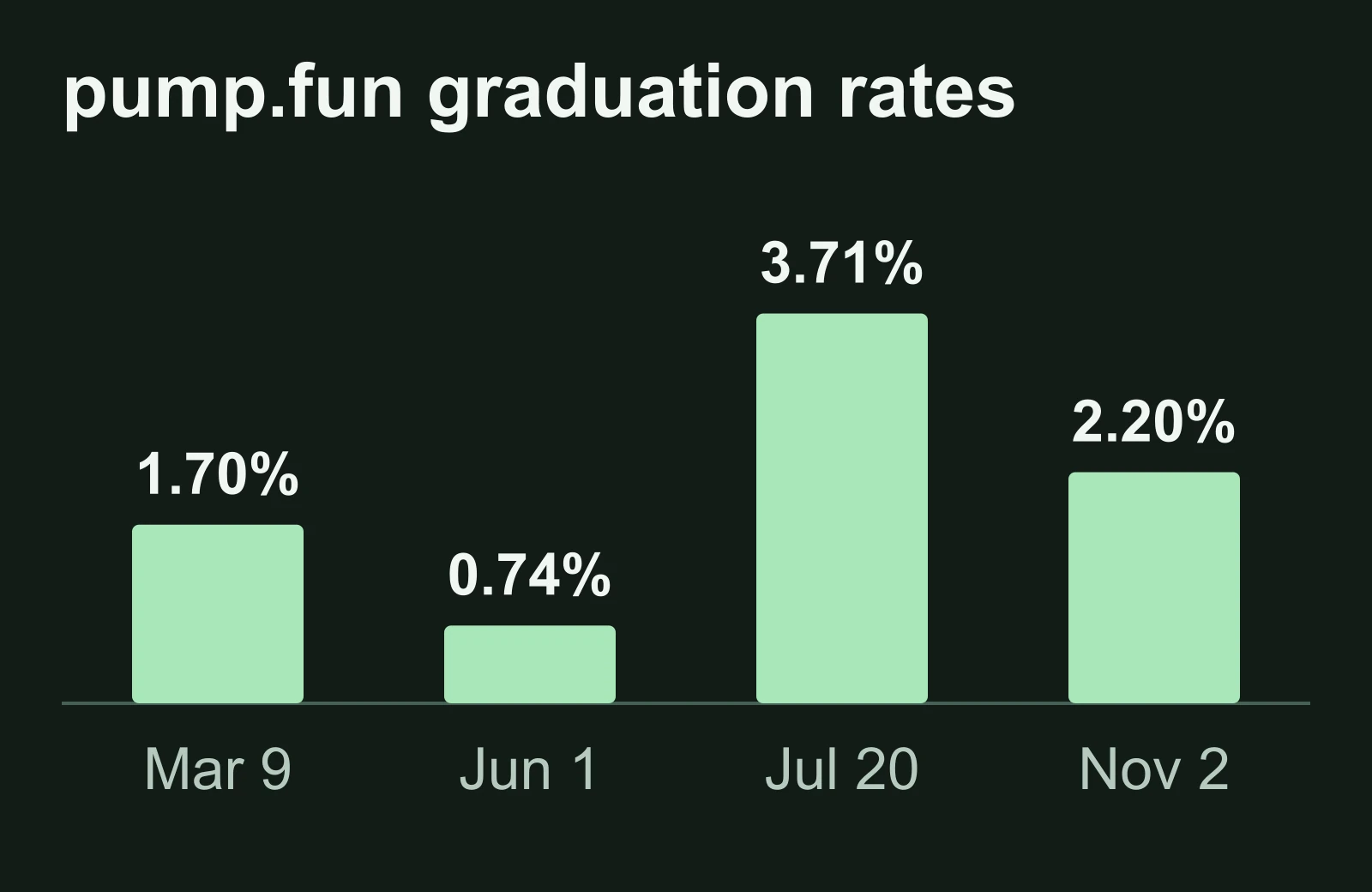
About 2% in autumn 2026, up from under 1% in the spring. Over pump.fun's first two years the rate was 1.02%. Graduating means selling out the bonding curve and moving to an exchange pool; it isn't the same as succeeding.
| Period | Graduation rate | Based on | Source |
|---|---|---|---|
| Jan 2024 – Jan 2026 | 1.02% | A sample of 15.2 million coins | Carnegie Mellon / EPFL |
| September 2025 | About 0.63% | 4,338 of 655,770 coins | Marino and others |
| Nov 2025 – Oct 2026 | 1 in 58 | pump.fun launches | Bitquery |
| Week of 9 March 2026 | 1.70% | 3,252 of 191,626 | Dune |
| Week of 1 June 2026 | 0.74% | 1,426 of 191,591 | Dune |
| Week of 20 July 2026 | 3.71% | 7,044 of 189,917 | Dune |
| Week of 2 November 2026 | 2.20% | 6,503 of 294,958 | Dune |
Why the rate jumped in July 2026
On 21 July 2026 pump.fun introduced BOOST for every new coin: part of the liquidity that used to be lost when a coin graduates, 17.6 SOL on a SOL-paired coin, is spent buying the coin back and burning it over the five minutes after graduation. The weekly rate was already rising, from 0.91% to 2.40% over the four weeks before, and reached 3.71% in the week BOOST began.
Since then graduation says less about demand. Bitquery found that a third of September 2026's graduations took three trades or fewer. Sources also disagree for the same weeks: The Block reported a seven-day average of 0.26% in mid-June 2026, where the Dune query shows 0.74% to 0.78%.
Sources: the Dune query, Bitquery, Marino and others, The Block's reports of 16 June and 29 July 2026, and pump.fun's announcement. Memecoin graduation explains the step itself. What is BOOST? shows how it runs.
How long does a memecoin last?
Usually less than a day. Half of pump.fun's launches make their last trade within about three minutes, and roughly seven or eight in ten never trade again after the day they launch.
| Measure | Figure | Covers | Source |
|---|---|---|---|
| Last curve trade on the day of launch | 68.67% | 18.7 million coins, Jan 2024 – Jun 2026 | CoinGecko |
| Dead by the next day | 80.37% | Same | CoinGecko |
| Still trading on the curve after 90 days | 4.55% | Same | CoinGecko |
| Never traded after launch day | 79% | 9 million coins, Nov 2025 – Oct 2026 | Bitquery |
| Half of launches made their last trade within | About 3 minutes | Same | Bitquery |
| Any trade in the coin's fifth week | 1 in 65 | Same | Bitquery |
The two sources measure differently, so don't average them: CoinGecko counts trades on the bonding curve only, by calendar day, while Bitquery counts every exchange trade. Bitquery gives the launch-day figure for other launchpads too: 51% for Meteora's and 84% for Raydium LaunchLab's. Sources: CoinGecko and Bitquery.
What happens to coins that do graduate?
Most fall hard. Researchers who followed 41,470 pump.fun coins that graduated between December 2024 and March 2025 labelled 84% of them high-risk: the price dropped below 30% of its graduation price afterwards, or a review found manipulation.
From MELT, a Georgia Tech dataset. “Linked wallets” are ones that bought in one transaction, shared a funding wallet or shared a bundle. How to check if a memecoin is bundled shows how to see that on a single coin.
Do memecoin traders make money?
Many end a month slightly ahead on what they've sold; few make much. In April 2026, 73.3% of 3.1 million wallets trading on pump.fun had a positive realized result, but most of those made under $500, and 5.4% made more than $1,000.
These figures count only coins a wallet has sold. Coins still held, and now worth little, aren't in them. A different dashboard, reported in March 2026, found about half of wallets had lost money that month. The two agree on the part that matters: about one wallet in twenty takes out a meaningful sum.
Sources: CoinGecko, published 7 May 2026, and crypto.news, 30 March 2026.
How common are copies, bundles and wash trading?
Common enough to plan for. Over one coin in ten on pump.fun is a copy of an earlier coin, and at least 17% of trading transactions in a large sample were wash trades: the same people buying and selling to make a coin look busy.
| Finding | Figure | Source |
|---|---|---|
| Coins that copy an earlier coin's name, ticker, description and image | At least 1.5 million, over 10% | Carnegie Mellon / EPFL |
| Originals that graduate, against their copies | 9.20% against 0.86% | Carnegie Mellon / EPFL |
| Wash trades, as a share of trading transactions | At least 17% | Carnegie Mellon / EPFL |
| Coins with at least one sudden sell-off, among those with 30 or more trades | 92.22% | Marino and others |
Copies are called vamp coins. How to spot a memecoin rug pull turns these findings into checks. Sources: Meme Coin Factories and Marino and others.
What do creators earn?
pump.fun has paid creators $673.1 million in creator rewards in total, according to Blockworks' dashboard on 24 November 2026. With over 25 million coins created, that averages about $26 a coin, and most of it goes to the few coins that trade heavily.
The average is our own division of the two Blockworks figures. A creator earns 0.30% of each trade on the bonding curve; pump.fun creator fees has the rates after graduation, and the pump.fun calculator works out a volume of your own. Source: Blockworks.
How to read these numbers
Every figure here is someone else's measurement, read on its own page on 24 November 2026. We give each with the dates it covers because memecoin numbers change fast and old ones keep circulating without a date.
- Windows differ. A rate for one week and a rate for two years aren't comparable. Check the “covers” column.
- Definitions differ. “Dead” can mean no trade on the curve or no trade anywhere; “profitable” can leave out coins not yet sold.
- Sources disagree. Where two give different numbers for the same period, both are shown.
- Preprints aren't final. The arXiv papers are research manuscripts; one is accepted at a security conference, the others aren't peer reviewed yet.
- Nothing here predicts a coin. These are averages over millions of coins.
Risks
Memecoins are highly speculative, and these numbers show how: most coins stop trading within a day, and most of the rest lose nearly all their value. Nothing here is financial advice.
- Past figures don't tell you what a particular coin will do.
- A rising graduation rate doesn't mean coins have become safer to buy.
- Only use money you can afford to lose entirely.